The thinning of the Sunday paper
I was in the middle of my elementary years when I began the habit of reading the broadsheet. It’s weird for a kid to read a broadsheet, but it’s nice to look intelligent. During that time—the time before AI, social media, and smartphones—the Sunday paper was my companion. The Philippine Daily Inquirer was still P18 (now it’s P25), yet the pages and articles were enough to get me by through Sunday. News and opinion comprised most of it, but the Inquirer’s lifestyle and entertainment sections were worth the read, too.
Back then, Lola made it a habit to buy newspapers—the Inquirer and Philippine Star. Of course, my bias is the Inquirer. Although am not sure why she had that habit it because I never really noticed adults in the house read the paper. My guess is that she just found it convenient to grab a newspaper or two before going home after her weekend market run.
Newspapers made me literate. I did not have a lot of books; nor did I find DepEd’s textbooks an attractive read. But the stories of Gloria Macapagal-Arroyo’s corruption, photos of activists getting teargassed and/or water cannoned (when calibrated preemptive response was still a thing), Letty Jimenez-Magsanoc’s editorials, Conrado de Quiros’s “There’s the Rub” pieces, and “Young Blood” essays (which I had the honor of being published twice) always piqued my attention. “Comic Relief” was also a thing! The Inquirer also allowed my eight-year-old self to be updated, from time to time, of the US War on Terror in Iraq and Afghanistan.
For some reason, my habit of reading the broadsheet stuck around—and it became a gateway for me to explore other forms of literature, like encyclopedias, general reference books, and, eventually, fiction.
And fast-forward a few years, I became involved in this thing called campus journalism. Imagine my joy when I pivoted from being a mere reader of a newspaper to actually writing for the campus paper and managing the newsroom.
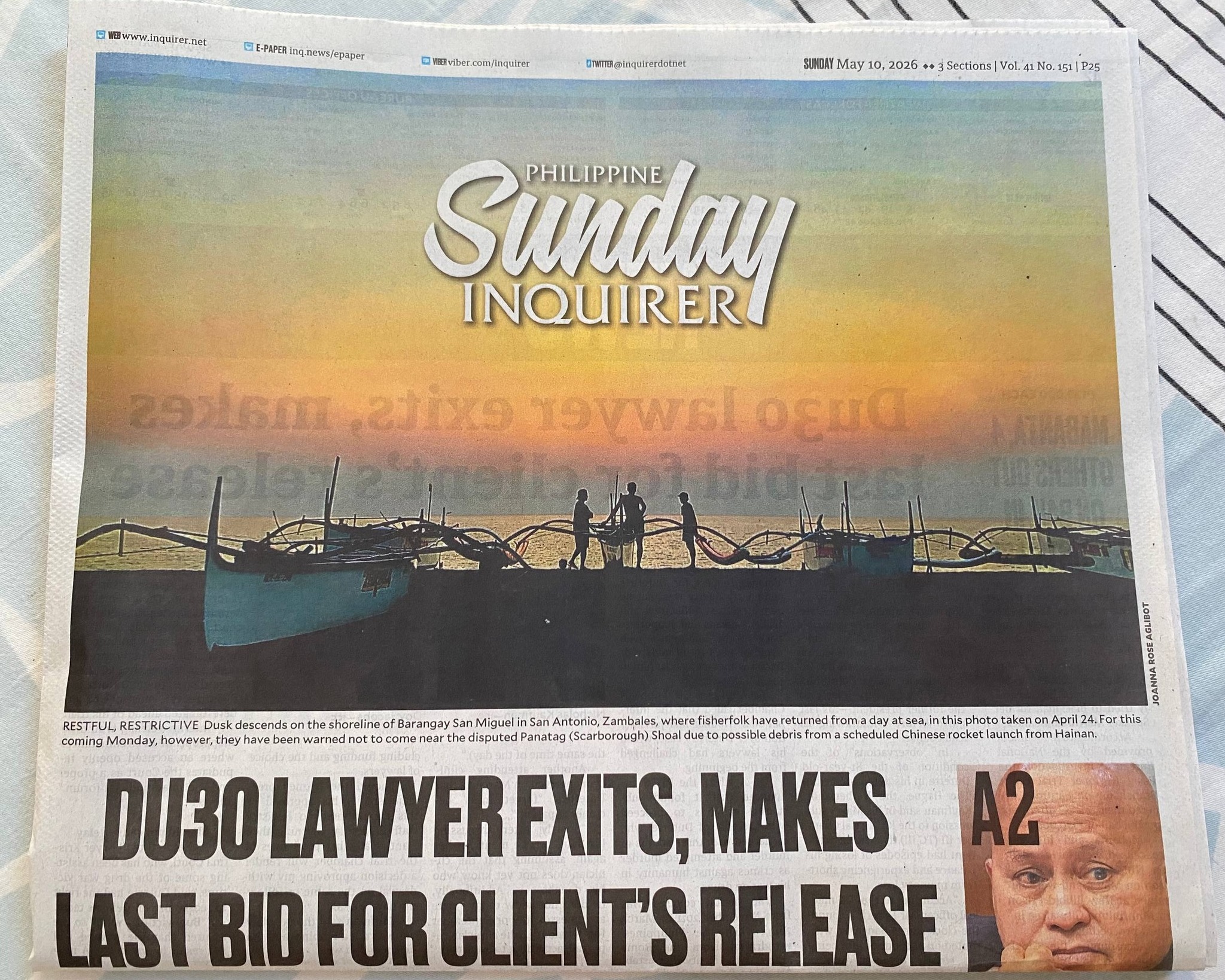
These years of being a newspaper reader (and fan) allowed me to notice changes in the print media. In 2016, the Inquirer abandoned its old design language (which it was using since its founding in 1985) and redesigned its broadsheet to have a modular and cleaner look. However, as more years passed by, the Inquirer became thinner—not because of sleek design, but because of fewer pages. It used to have at least four sections (news, business, lifestyle, and entertainment) with 50-plus pages, but today’s Sunday paper only has three sections (news, business and lifestyle) with 20-something pages.
Also gone are the days when organic articles were published in the newspaper. Now, the Inquirer even publishes articles from the State’s mouthpiece, the Philippine News Agency. (What happened to “Balanced News, Fearless Views?”) I will demur. This isn’t a piece criticizing the print media. I am aware that there are political and economic forces behind those editorial decisions.
I guess I am just thankful for my grandparents and parents for tolerating my reading habits. I still intend to read newspapers, not because of nostalgia, but because of my belief in the power of print media to form an intelligent citizenry. Reading the news on a smartphone from a social media platform is nothing compared to physically reading a broadsheet. The sensory treat of smelling a fresh newspaper and reading decent prose sans fake/troll accounts or “haha” reacts is a rare delight.
In a time where we’re all just angry against each other’s views, perhaps some of us might consider changing our information diet. We are oversaturated with news. The newspaper—thinning it may be—allows us to consume news that matters, without the noise. Social media leaves me angrier. Broadsheet leaves smudges of black ink on my fingertips.