How to think about the ‘income advantage’ in entering UP
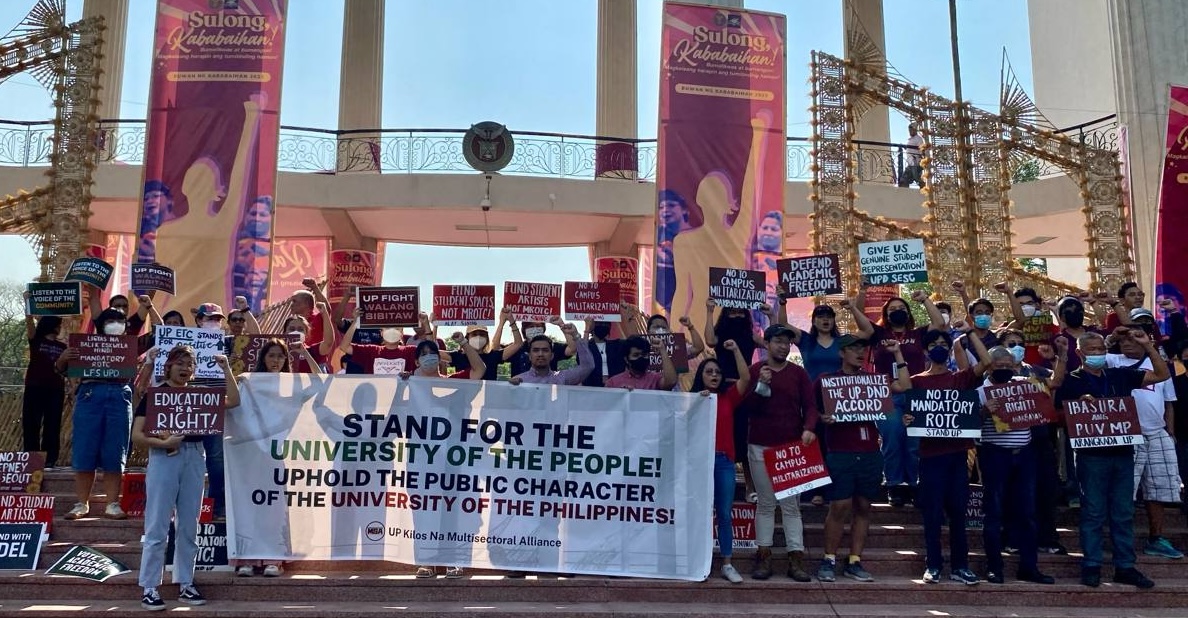
The right to quality and accessible tertiary education–especially when mandated by law–cannot be abrogated once a showing of an imperfect policy execution is revealed.
Such is the case with the implementation of the Free Tuition Policy (FTP) in the University of the Philippines (UP).
The mainstream media has gone abuzz over the 2022 study of researchers led by economics professor Sarah Lynne Daway-Ducanes, which concluded that “applicants coming from higher income families have a higher likelihood of being admitted to the UP system and into their first-choice courses.” The study suggested that the FTP “is more likely to disproportionately benefit students coming from higher-income families.”
The FTP is the product of a decades-long struggle by the youth and student sector. It stems from the duty of the state to provide quality education at all levels and make it accessible. No less than the 1987 Constitution dedicates an entire article relating to education. The Universal Declaration of Human Rights, which is considered the international bill of rights, also provides that everyone has the right to education, “and higher education shall be equally accessible to all on the basis of merit.”
In UP, the struggle has been long drawn. The national university began where students will fully pay for their matriculation. Shortly after the EDSA Revolution, UP increased tuition but “socialized” it–those who have a higher capacity to pay will pay the full rate, while those who cannot, will have a discount, depending on one’s socioeconomic stratum. This became the Socialized Tuition and Financial Assistance Program (STFAP).
In 2006, UP tripled its tuition fee to P1,500 per unit and revised the STFAP to provide for a new bracketing scheme. The STFAP was reformed in 2013 and was renamed Socialized Tuition System (STS). During the pandemic, UP phased out STS and reintroduced it as the Student Learning Assistance System (SLAS), where students can apply for tuition discounts, financial support and learning assistance. Despite the alphabet soup, the concept remained the same.
With the implementation of the FTP in 2017, the STS/STFAP scheme largely ceased (except for those who were not qualified to benefit from the FTP) as the entire matriculation is now paid by taxpayers’ money.
That the admission policy of UP and possibly other state universities and colleges suffers from an “income advantage” is a fact known to lawmakers when they legislated the FTP. Cielito Habito, the architect of the Ramos administration’’s neoliberal economic policies, has opposed the FTP precisely because it pours government funds to students and families who can afford paying matriculation (Habito only wants the FTP to be targeted). Despite these quantitative facts and arguments, Congress has nevertheless pushed through with FTP.
We cannot now walk back the FTP by using the same arguments that the policymakers themselves have sidelined. To do so would be a tacit admission by the entire state apparatus that it was wrong to pour billions of peso to state universities, which produced intellectuals and professionals who have since offered their talents in one way or another.
The FTP states, in a clear-eyed declaration, that quality education is an inalienable right of all Filipinos. In fact, if the state is truly sincere in fulfilling this inalienable right, steps should be taken to further accessibility to quality education. Removing the barriers to entry, and providing nonmatriculation financial support are some of the next steps that the government must take, post-FTP. Expanding–not scaling back FTP–is the right policy forward.
Leave the FTP alone. In universities lie the remedy in fixing, if not eliminating, the “income advantage.” For one, an alternative and equitable admissions process is mandated by law for UP to implement. This affirmative action must enhance the access of disadvantaged students and students from depressed areas. In other words, UP has the power to implement an admission system that gives economically and geographically disadvantaged students a fighting chance to enter the national university.
The Daway-Ducanes study recognized that the Excellence-Equity Admissions System, which is UP’s affirmative action scheme, could be revisited and recalibrated “to ensure that good students from poorer backgrounds are sufficiently represented in the pool of admitted students.” This tweaking of the algorithm could be very well done by the university alone without changing a single letter from the FTP, nor excluding a single student from the law’s coverage. UP, for its part, should strongly consider a more radical democratization of its admission. UP’s goal is not to admit good students, but rather to create them.
This chatter about the “income advantage” vis-a-vis the FTP only reveals that the right to education remains a promise. Rights are blind to one’s socioeconomic status. One cannot have more rights simply because they are richer. The solution is not to take away the right to remove the inequities. Rather, the goal should be to expand the right to make it as accessible and as universal as we envisioned it to be. It means expanding, not slashing, the FTP. It entails a commitment to move closer to a truly free, quality, and accessible education.