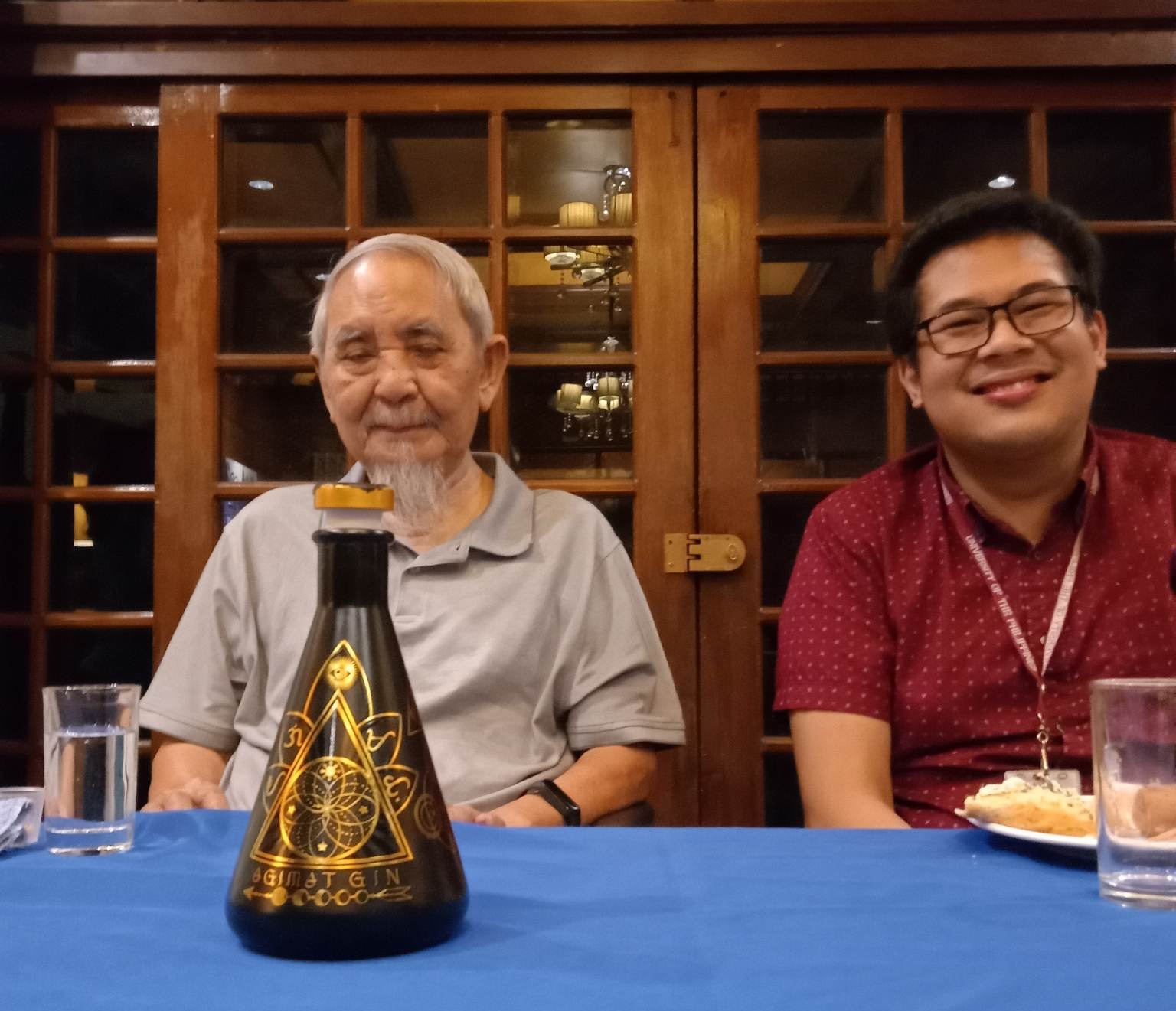
Dodong, 89
I first met Francisco “Dodong” Nemenzo in late 2022, when his son, Fidel, was a nominee for the UP presidency. I knew that Fidel’s dad used to be a UP president, but I didn’t know what Dodong looked like. Inside Balay Tsanselor, there was Dodong, already 87, seated at the corner of the table, beside his caregiver.
Fidel’s wife, Marivic Raquiza, introduced me to Dodong, saying I’m the editor of the Philippine Collegian, and I was also a physics student (believe me, it always amazes people). Dodong was mumbling and I had to lean toward him just to hear what he was telling me. Dodong asked me, “You’re a physicist but you write for the paper?” “I have to,” I said, jokingly (or was it?). Then, he proceeded to tell me that he knows a bunch of physicists from the institute–most of them dead or already retired.
Dodong belonged to the generation of intellectuals who predated the Martial Law era of Marcos Sr. Dodong and the late Jose Maria Sison, the founder of the Communist Party of the Philippines, were among the most prominent thinkers of the Left during the 1960’s. Sison and Dodong had their doctrinal differences in the revolutionary movement, but remained close friends. In fact, Sison and Dodong had written to each other almost weekly when the latter was taking his PhD at the University of Manchester.
Throughout the tumultuous Marcos regime, Dodong remained firm in his activism, despite being a university administrator. He was imprisoned and tortured during the dictatorship. Nevertheless, he became a college dean in the late 1970’s, a faculty regent, and the chancellor of UP Visayas from 1989 to 1992. Dodong became the founding chair of Bukluran sa Ikauunlad ng Sosyalistang Isip at Gawa (BISIG), an above-ground socialist organization in 1986. He was also the chairman of the democratic socialist party, Laban ng Masa. Dodong’s identity was a blend of being an academic and a progressive thinker, two inseparable sides of the same coin.
Dodong first threw his hat for the UP presidency in 1993. He was endorsed by the Collegian, during the term of my predecessor, Bernard Cobarrubias. Emil Javier was eventually selected as the 17th president, amid the UP community’s call for a more democratic selection process (they proposed selecting the president through a direct vote). It was, however, a temporary setback. Dodong eventually succeeded Javier as the 18th UP president, ushering the university through the new millennium.
Interestingly, it was during Dodong’s presidency that UP issued a 2003 memorandum prohibiting prayers in the classroom. In defense of freedom of religion and the secular state university, Dodong wrote, “one is free to pray silently to any God, but he/she cannot use his/her authority as a teacher to get the students to do the same.”
While his term ended in 2005, Dodong remained to be a prominent thinker in the university, and a social critic. He continued teaching, despite his age. In fact, a Blogspot for his Soc Sci 2 class in 2012 remains on the Internet (a pioneer in remote learning!). In 2007, Dodong (who was then the Laban ng Masa chair) released a statement condemning Sison’s arrest by Dutch authorities. He called the arrest of his friend, Sison, as a part of the “threats and harassment instigated by the Arroyo and Bush governments.”
Dodong remained sharp despite his progressing age and deteriorating health. During our occasional interactions, he always gave this aura of an elder statesman. Dodong joined rallies in defense of academic freedom and democratic governance. In fact, when Fidel was selected chancellor in February 2020, Dodong, who was then a few days away from his 85th birthday, attended the mobilization while in a wheelchair.
I learned of Dodong’s death when Marivic told me earlier today. Coincidentally, he died three days after Sison’s second death anniversary. Two of the most prominent Marxist thinkers of the country have now passed. Their death notwithstanding, the Movement continues regardless of one’s doctrinal position, but nevertheless still hopeful of a united Philippine Left.
Dodong’s scholarship, activism, and legacy will endure for generations to come. He is unafraid of questioning dogma and critiquing, when necessary, ideologies. The Movement, after all, is not monolithic. As he wrote in 1977, “to understand the inner workings of the movement and forecast its response to future crises, it is more useful to stress the ‘polycentric’ character of the Philippine Left rather than reiterate the legend of its ‘monolithic solidarity.’”
At a time of increasing geopolitical strife and domestic power struggle, Dodong’s perspectives, buttressed by his firm grasp of the Left’s history and origin, will be a valuable resource in understanding the Movement and navigating the challenges of advocating for meaningful change.
Rest in power, Ka Dodong.