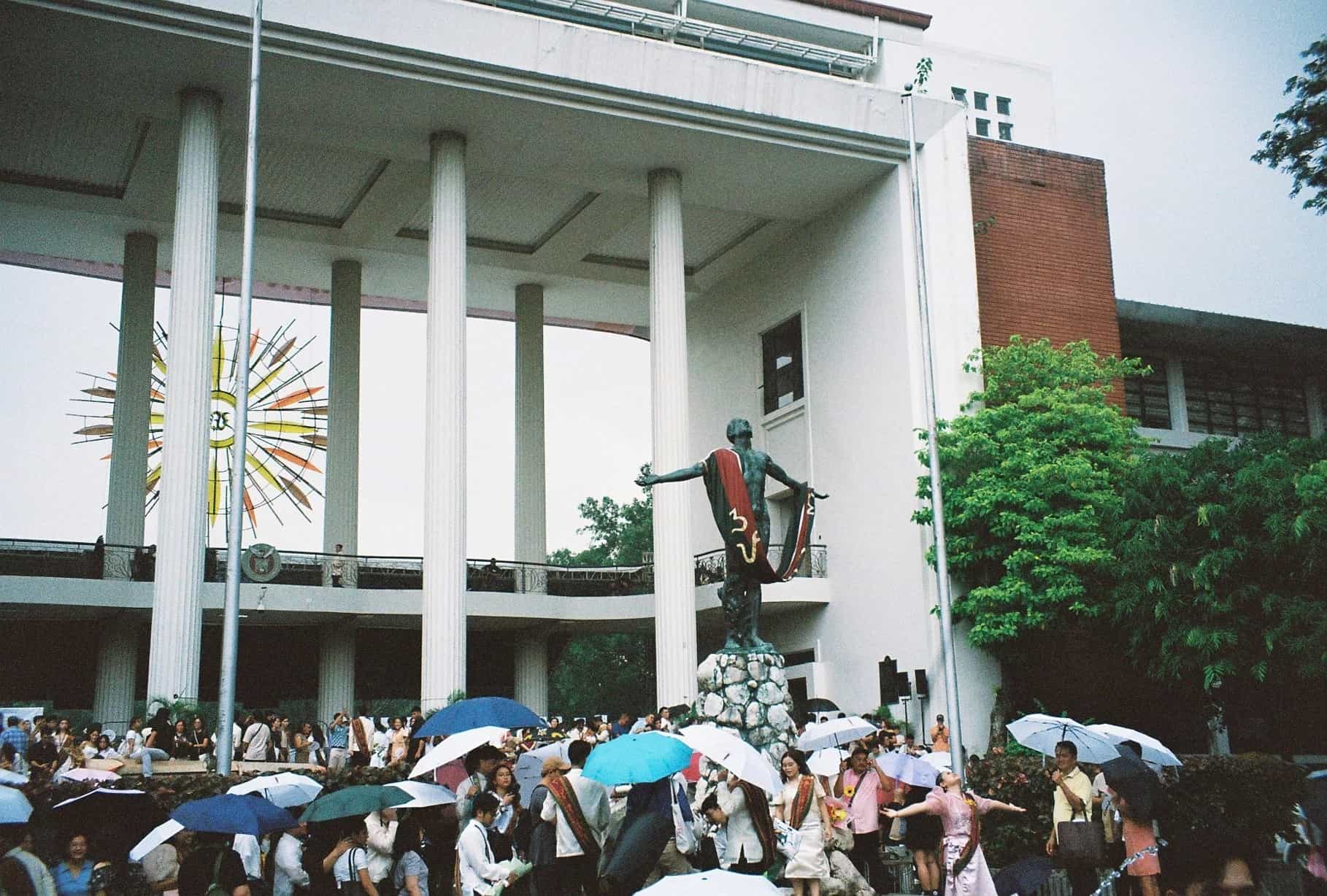
One year after graduation, what now?
I like to think that the stages—eras, if you will—in our lives are marked by certain events. These markers are akin to the layers of filth that accumulated on the Earth. When a layer of rock becomes fundamentally altered, scientists may delineate the two (or more) layers into different epochs. For instance, when the Earth got hit by a massive asteroid some 66 million years ago, it radically changed the face of the Earth, prompting said event to become the marker between the Cretaceous and Mesozoic eras. And we know these facts are real because the principle of superposition tells us that rocks and soils are deposited horizontally and chronologically—the layers become more aged as you dig deeper.
For humans, these life markers are fuzzy and arbitrary. When I first experienced a real heartbreak back in the summer of 2019, I thought it was a turning point—a marker. But it was a purely personal experience for me, the pain and ugliness of it all. And not everyone noticed. Graduations may also be deemed a boundary. Many think it’s a ceremony that marks one’s crossover from a sheltered life to the so-called real world. (As if the years before graduation weren’t the “real world.”) It’s a day of pomp and celebration; a transition of sorts—with an expectation that you now must look after yourself. We can stretch it toward absurdity: the death of Harambe, the phasing-out of Jollibee’s ultimate burger steak, the renaming of Twitter to X—these can be markers, too!
I asked David and Dustin last week what their plans post-July 6 are. (UP’s commencement ceremony is on July 6.) But before they were able to answer me, I interrupted, telling them that you don’t have to think about it right now—it might be more prudent to savor first the weird interregnum between finishing your coursework and actual graduation. But David has plans, he is mulling over whether he’ll enroll in the UP College of Medicine. (I think he should.) Dustin is keen on working already, but he’s also keen on not working for UP and not entering UP for graduate school. For them, the graduation is a marker of the move from undergraduate to further studies and working.
There is beauty in every turning point in our life. Every new stage is a chance to do-over things, ditch the unwanted habits, cut-off the unnecessary persons. In a way, it’s a time to start anew, but not from scratch, but with the experience and wisdom you’ve accumulated in the years preceding. In the words of our dean, “you’re beginning another semester with the first semester under your belt.”
It isn’t always the case, though, that these markers or boundaries come naturally; nor one can always expect that they will proceed as planned. Remember, the dinosaurs went extinct after an asteroid collision and the event abruptly ended the Cretaceous era! I was reflecting on these points, alongside the mumblings of my friends who will graduate this July. A few ideas come to my mind.
There may be some truth to the saying that taking graduate school immediately after college is a way to skirt around “real life.” Of course, who even wants to worry about bills and chores, when you can just continue studying and leeching off from your parents? (I may or may not have lifted the line from JSP.) Graduate school is a safe path; it’s a safe bet. It’s a low-risk, high return scenario—after all, you become more palatable to employers as your post-nominals lengthen (e.g., Dr. Santiago Dela Pacion, RN, MA, MS, PhD, ILY, MBTC, HBD, MD, TY, IMY …).
We study and earn our degrees to work. This is why universities and colleges are hell-bent on making sure that their curriculum is aligned with what the industry needs. (Consequently, this leads to the removal of subjects which the employers do not need, like the arts and humanities. But that’s a story for another time.) Naturally, college graduates go job-hunting immediately after graduation (and some, even before graduation) because parents would want to cut-off support already. For them, the graduation is a marker of their responsibility to their child; after which, they’re truly on their own.
The decision what path to take, however, is primarily decided by one material point: privilege. It takes an enormous amount of privilege to hold-off work and continue to drain your family’s coffers to fund graduate studies. It is a privilege that allows one to study comfortably, without thinking about the bills, rent and utilities due every month. (Wouldn’t it be nice to read the assigned cases and commentaries without worrying about those things?)
So, I circle back to where I began this mumbling. And, of course, I say this with the benefit of retrospection and a year’s worth of wisdom: graduation may not be a turning point for some of us. I personally know friends who have begun working even before graduation, and their ceremony will just be an affirmation of what they did during college. For our privileged peers, the graduation is just another boost to the head start they already have. And for the rest of Filipino students who are just barely making ends meet, graduation will just mark a stage where their academic struggles are transformed into “real world” struggles. Of course, hopeful that, perhaps, it’s their way out of poverty.
As for me, I don’t know what lies ahead. Studying under a scholarship grant with exacting academic standards forces me to live by semester in the law school. I cannot plan my life beyond the next five months. As I told Seth during the finals week, just a notch below 85% could spell withdrawal from the program. Even with the grant, sustaining oneself remains a difficulty.
A year after graduation, it still feels like a turning point. I am just one-quarter of the way, with six semesters to go. Deciding to enter graduate studies just made the stakes higher because I do not have the assurances that someone or somebody will cushion my failure. To avoid failure at all costs, sometimes to the point of exhaustion and emptiness. Here’s to hoping this is not yet an extinction event.
I think this rambling has been too long already. I just wish I could say that the fresh graduates can hope for a better life after graduation. It’s not. Nothing could trump the comfort and foolishness of life before the “real world.” Graduation is akin to being removed from a life-support machine! But we can always make for a future where we’re no longer treated like cogs in a machine. I hope we start to see ourselves less as a mere human capital, but as persons with dignity–with dreams and desires. In that way, we make our graduations no longer as a rite of passage to the “real world,” but rather a bridge to our more profound and meaningful and collective aspirations.