Could 2025 be a year of comeback for Makabayan Bloc?
If the elections were to be held last month, the Makabayan Bloc’s four party-lists would have all won at least one seat in the House of Representatives.
That, at least according to the poll conducted by the Social Weather Stations released on December 27, 2024. The polling field work was conducted on December 13 to 18, 2024, with 2,097 registered voters as the respondents.
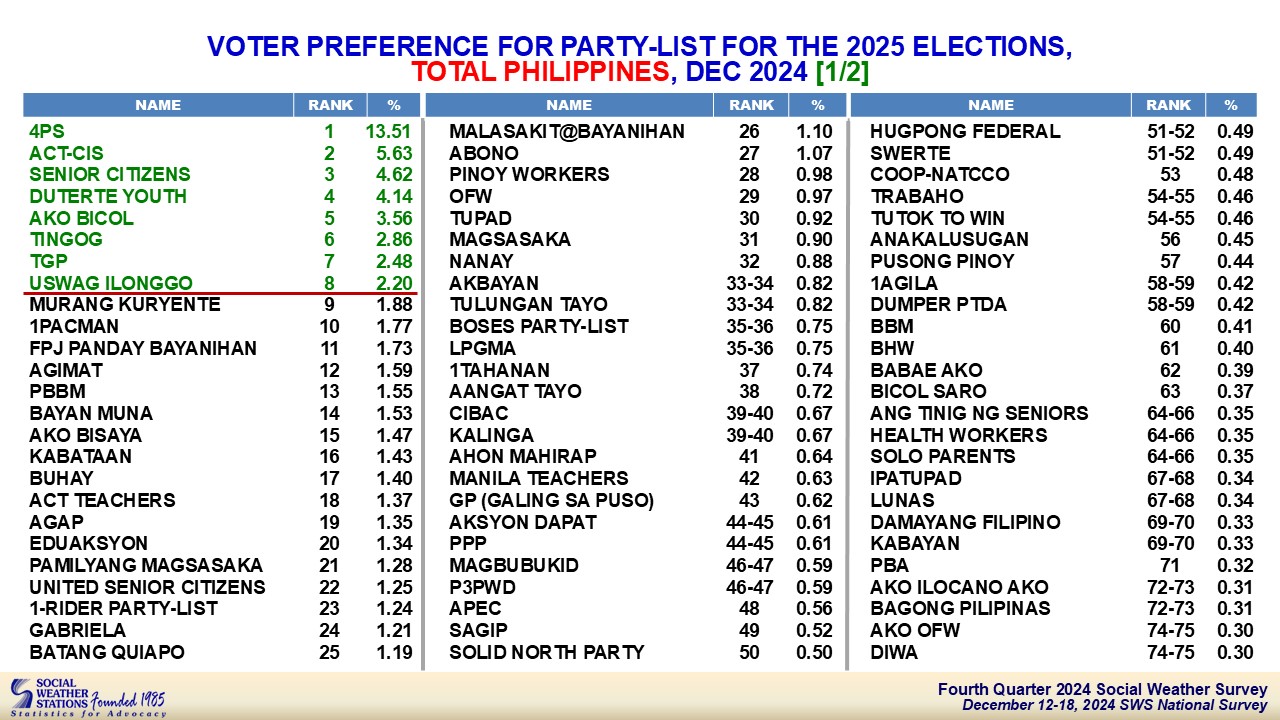
The poll showed that Bayan Muna, Kabataan, ACT Teachers, and Gabriela Party-lists were ranked 14th, 16th, 18th, and 24th, respectively. If the polls were spot on, all of them would send their first nominee to the next Congress.
That means a Congressional comeback for veteran lawmakers Neri Colmenares (Bayan Muna) and Antonio Tinio (ACT Teachers). Meanwhile, Sarah Elago, who was a former Kabataan Party-list lawmaker, would also be returned to Congress, this time as a Gabriela Party-list solon. Finally, lawyer and former UP Student Regent Renee Co would replace Rep. Raoul Manuel (who is age-limited) as the Kabataan Party-list representative in the 20th Congress.
This is a net gain of +1 for the progressive bloc, which currently has three members in the House of Representatives. The polls’ results would also allow Bayan Muna to rejoin Congress, after narrowly losing in 2022.
How seats are computed
Since 2009, party-list seats have been awarded through a formula crafted by the Supreme Court in its decision in BANAT v. COMELEC (G.R. 179271, April 21, 2009).
Originally, the Party-List Law mandated that a party must win at least 2 percent of the total votes cast for party-lists to get one seat. Hence, to get two seats, a party-list must receive at least 4 percent of the votes, while 6 percent is required for a full three-seat complement.
That has since been reinterpreted (or, really, struck down) in BANAT. The court noted that the 2-percent threshold frustrated the constitutional command that 20 percent of the House of Representatives must be party-lists. Prior to BANAT, not all party-list seats were awarded as there weren’t many parties who were able to clinch the 2-percent threshold.
Hence, the BANAT Court laid the guidelines for computing the party-list winners, as follows:
The percentage of votes garnered by each party-list candidate is arrived at by dividing the number of votes garnered by each party by 15,950,900, the total number of votes cast for party-list candidates. There are two steps in the second round of seat allocation. First, the percentage is multiplied by the remaining available seats, 38, which is the difference between the 55 maximum seats reserved under the Party-List System and the 17 guaranteed seats of the two-percenters. The whole integer of the product of the percentage and of the remaining available seats corresponds to a party’s share in the remaining available seats. Second, we assign one party-list seat to each of the parties next in rank until all available seats are completely distributed. We distributed all of the remaining 38 seats in the second round of seat allocation. Finally, we apply the three-seat cap to determine the number of seats each qualified party-list candidate is entitled.
Applying the BANAT guidelines in the SWS survey
BANAT tells us that we must get the vote share of the party-lists first. That means dividing the vote earned by each party-list by the total votes cast for the party-list contest. SWS’s survey, luckily, already reported the party-lists’ projected vote share.
Next, we look for the party-lists whose vote shares were at least 2 percent. In the SWS survey, those are: 4PS, ACT-CIS, Senior Citizens, Duterte Youth, Ako Bicol, TINGOG, TGP, and USWAG ILONGGO Party-lists. Hence, these eight are now assured of one seat. This is the first round of seat allocation.
Now, we note that in the 2025 elections, there are 63 party-list seats up-for-grabs. This is important because the BANAT guidelines mandated that all slots must be filled.
We now move to the second round. Here, we subtract the number of seats awarded in the first round–eight–to the 63 party-list slots. Hence, we have 55 seats left to allocate in the second round.
In the second round, we simply multiply each party-list’s vote share by 55, rounding down any fractional seat (hence, 2.99 is 2, not 3). Let’s call this the calculated seat. Here’s a spreadsheet:
When a party’s calculated seat is below 1.00, (i.e. 0.9735, like 1PACMAN) disregard it. That’s 0 seats. So far, we have distributed 19 seats for the second round.
We now move to what I call the third round. Essentially, we just assign one seat for all the party-lists after rank 9 (lowest party-list who got a calculated seat above 1.00), until all 55 seats have been assigned.
Next, we add the seats allocated in the first, second, and third rounds. And we apply the three-seat cap. 4PS and ACT-CIS Party-lists have earned eight and four seats, respectively. We take 4PS’s five excess seats, and ACT-CIS’s one excess seat–six in total–and give them to the party-list who ranked after the last one in the third round.
Hence, the excess seats would go to party-lists ranked 46th to 51st.
We would see that, per the SWS survey, 51 party-lists will occupy the 63 seats for them in the lower chamber.
Why this matters
It is without a doubt that the Makabayan Bloc solons are one of the few, genuine peoples’ representatives in the elite-dominated Congress.
Tactically, this would also mean stronger clout in Congress–more signatories to proposed legislation, more avenues for the grassroots to participate in the legislative process, and a stronger opposition to hold the government accountable.
The return of Colmenares, Tinio, and Elago may also result in leadership posts for the progressive lawmakers in the minority bloc. These highly coveted positions in Congress are, after all, awarded not just based on numerical strength, but also seniority.
The prerogatives are self-evident. ACT Teachers Rep. France Castro, who is gunning for a senate seat, is a deputy minority leader in the current House. The role entitles her to sit in any committee of the House, and join them in scrutinizing legislation and holding legislative inquiries.
But rosy as it may, it is just a survey.
The needle will still move, as we’re still five months away from the May elections. However, these results are encouraging, if not a statement that not even state-backed red-tagging will not dissuade the people from voting for real, progressive change.